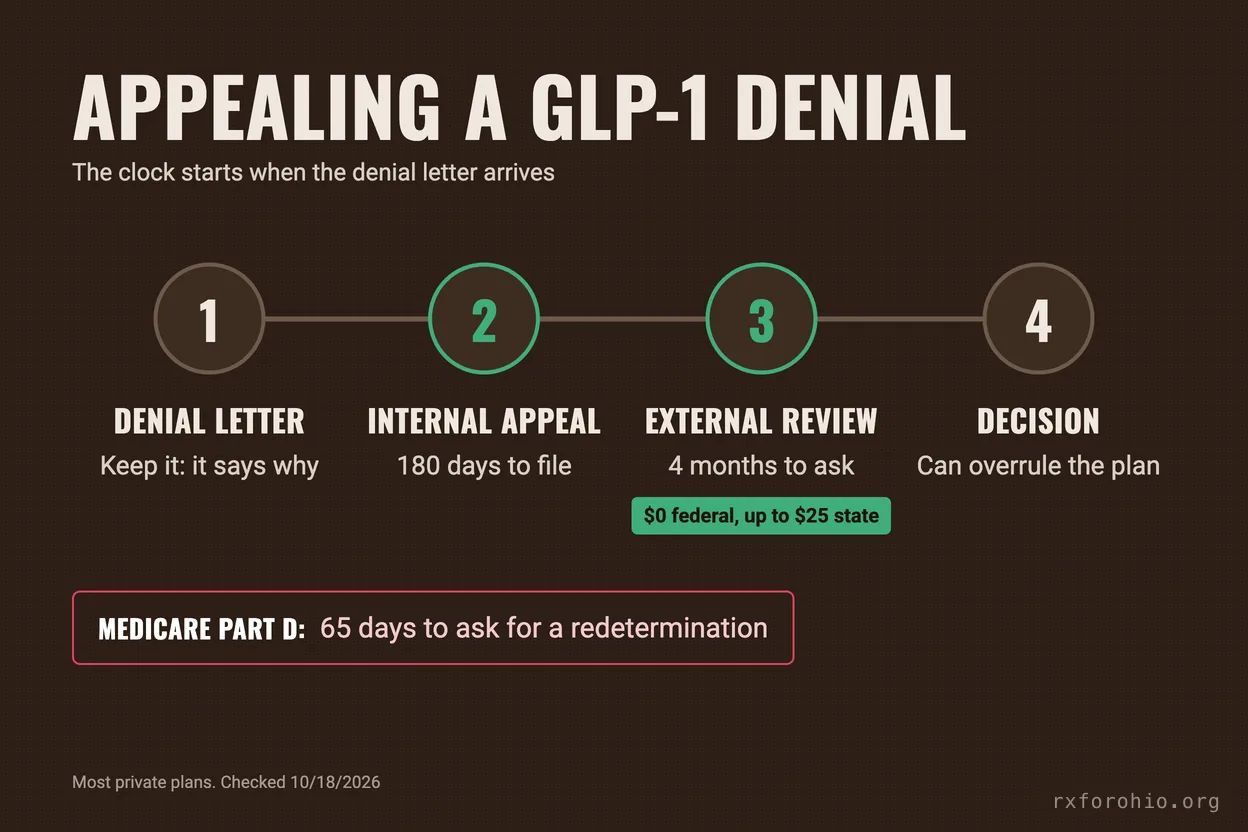
A GLP-1 insurance denial appeal starts with the denial letter. Your plan has to tell you why it said no, and how you can dispute it. On most private plans you then have 180 days to file an internal appeal (rules checked 10/18/2026). After that, an outside reviewer can overrule the plan.
Medicare Part D runs on shorter clocks: 65 days to ask your plan to look again. Below are the steps, the papers to gather, and the deadlines for each plan type. This is how the rules read, not legal advice. Your own plan's documents set the exact terms.
Why did your plan say no?
Start with the reason, because it decides how good your odds are. The denial notice should name it. It may come from your plan or from its pharmacy benefit manager, the company many plans hire to run the drug benefit.
Most GLP-1 denials fall into two groups. The first is a rule you didn't meet. That includes prior authorization, where your prescriber has to show you meet the plan's written criteria before it pays. It also includes step therapy, where you try a cheaper drug first, and quantity limits.
The second group is a flat exclusion: the plan doesn't cover weight-loss drugs at all. You can still appeal that internally. But outside review is built for a different kind of dispute.
HealthCare.gov lists the denials that can go to external review. The first is Any denial that involves medical judgment where you or your provider may disagree with the health insurance plan
. A denial for not meeting prior authorization criteria usually fits that. A benefit your plan never covered may not.
What documents do you need for the appeal?
Gather these before you write anything:
- The denial letter or Explanation of Benefits. It has your claim number and the plan's reason.
- The rule the plan used. Ask for it. For employer plans, the federal claims rule lets you get
upon request and free of charge, reasonable access to, and copies of, all documents, records, and other information relevant to the claimant's claim for benefits
(29 CFR 2560.503-1). - A letter from your prescriber. HealthCare.gov's internal appeals page suggests sending extra information
such as a letter from the doctor
. - Chart notes that match the criteria. If the denial says a requirement wasn't met, send the records that show it was.
- Your plan's own appeal form, if it has one. HealthCare.gov says you can also write a letter with your name, claim number and insurance ID number.
- A call log. Write down every call. HealthCare.gov suggests keeping
Notes and dates from any phone conversations you have with your insurance company or your doctor that relate to your appeal.
Keep your originals and send copies. Under the same federal rule, the plan has to weigh everything you send, even if it wasn't part of the first decision.
How long do you have, and how fast must the plan answer?
It depends on the plan type. Here are the deadlines for a drug you haven't filled yet, as the rules read on 10/18/2026:
| Plan type | File appeal within | Plan decides within | Outside review |
|---|---|---|---|
| Marketplace or other individual plan | 180 days | 30 days; urgent cases as fast as your condition requires | File within 4 months; decided within 45 days, or 72 hours if expedited |
| Employer plan, insured or self-funded | At least 180 days | 30 days (or 15 days per level if the plan has two); urgent: 72 hours | Plans that aren't grandfathered: same 4-month window to file |
| Medicare Part D plan | 65 days | 7 days; expedited: 72 hours | Independent Review Entity: file within 65 days; decided within 7 days, or 72 hours if expedited |
| Medicare GLP-1 Bridge | None given in CMS's prescriber guide | Prior authorization answer within 72 hours | Prescriber can resubmit for re-review |
| Source | What it says | Date checked | Link |
|---|---|---|---|
| HealthCare.gov, Internal appeals | File within 180 days of the denial notice; appeal completed within 30 days for a service not yet received | Checked 10/18/2026 | Open: HealthCare.gov, Internal appeals |
| HealthCare.gov, External review | Written request within 4 months; standard review decided within 45 days, expedited within 72 hours | Checked 10/18/2026 | Open: HealthCare.gov, External review |
| 29 CFR 2560.503-1, eCFR (Department of Labor claims rule) | Group health plans give at least 180 days to appeal; pre-service appeal decided within 30 days (15 per level with two levels); urgent within 72 hours | Checked 10/18/2026 | Open: 29 CFR 2560.503-1 |
| 29 CFR 2590.715-2719, eCFR (Department of Labor rule) | External review request may be filed within four months of the denial notice | Checked 10/18/2026 | Open: 29 CFR 2590.715-2719 |
| CMS, Redetermination by the Part D plan sponsor | File within 65 calendar days of the coverage determination notice; decision within 7 days, or 72 hours if expedited | Checked 10/18/2026 | Open: CMS, Redetermination by the Part D plan sponsor |
| CMS, Reconsideration by the Part D Independent Review Entity | File within 65 calendar days of the plan's redetermination notice; decision within 7 days, or 72 hours if expedited | Checked 10/18/2026 | Open: CMS, Reconsideration by the Part D Independent Review Entity |
| CMS, Medicare GLP-1 Bridge: information for prescribers (June 2026) | Prior authorization approval or denial within 72 hours of submission; a denial believed to be in error can be resubmitted for re-review | Checked 10/18/2026 | Open: CMS, Medicare GLP-1 Bridge information for prescribers |
How does an appeal work on a marketplace plan?
You file an internal appeal first. HealthCare.gov puts the deadline plainly: You must file your internal appeal within 180 days (6 months) of receiving notice that your claim was denied.
Individual plans get one round. Under 45 CFR 147.136, an insurer selling individual coverage must provide for only one level of internal appeal before issuing a final determination
.
If the answer is still no, the final letter has to tell you how to ask for external review. You have 4 months to file it. An independent reviewer decides, and HealthCare.gov says Your insurer is required by law to accept the external reviewer’s decision.
Your state may run the review, or the federal government may. A federal review costs you $0. A state process can charge a filing fee of up to $25, which is refunded if you win, waived for hardship and capped at $75 a plan year. The table below shows each one.