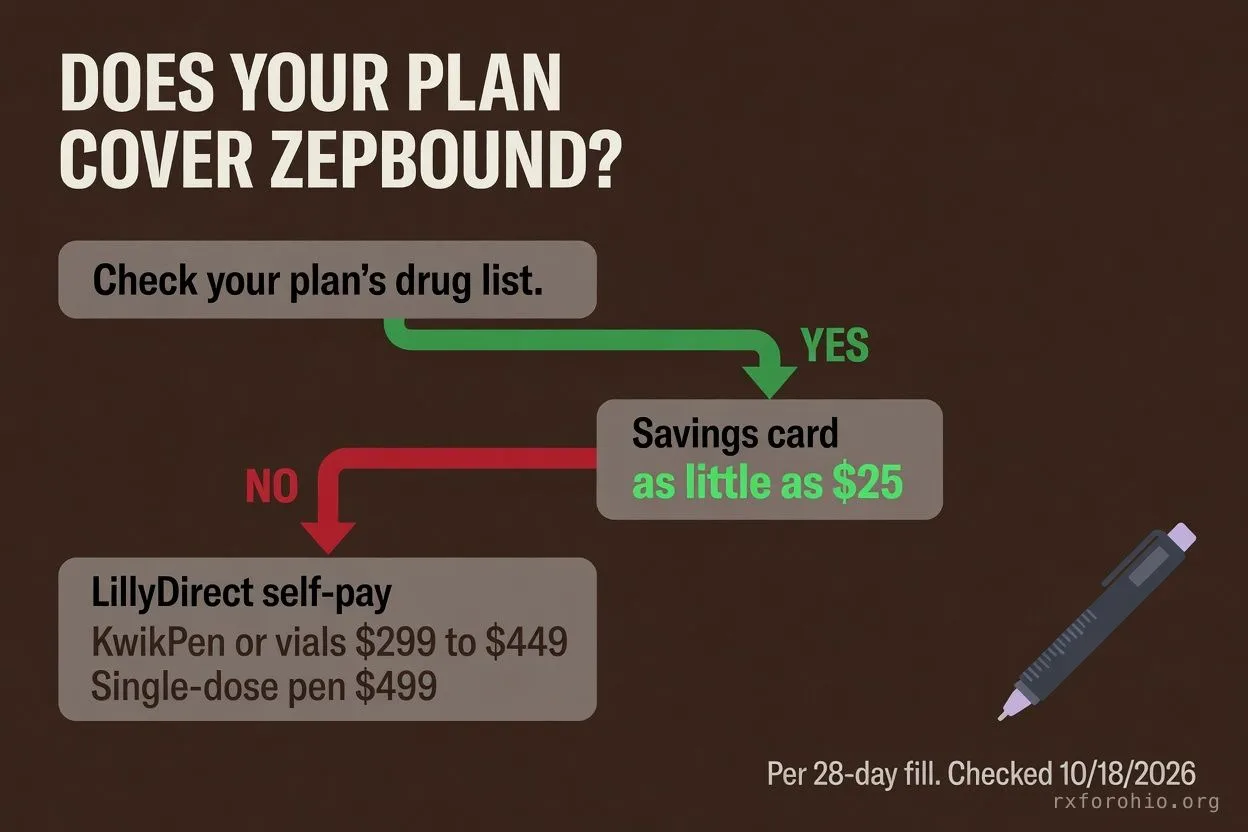
Does insurance cover Zepbound? Sometimes. It depends on two things: whether your plan pays for weight-loss drugs at all, and which diagnosis your prescriber puts on the request (checked 10/18/2026).
Plans that cover it may require prior authorization first. That means your prescriber sends proof that you meet the plan's rules before the plan agrees to pay.
If your plan covers the Zepbound single-dose pen, Lilly's savings card can cut a fill to as little as $25. If it doesn't, Lilly's cash prices for the KwikPen and vials run $299 to $449 a month ($449 needs a refill within 45 days; otherwise $499 or $699 at the higher strengths).
Why does Zepbound coverage depend on your employer?
Because the plan sponsor, often your employer, chooses what the plan pays for. Insurers publish standard drug policies, but your plan's own documents win if the two disagree.
Cigna says this outright in its Zepbound coverage policy: For example, a customer’s benefit plan document may contain a specific exclusion related to a topic addressed in a Coverage Policy.
So a plan can exclude a drug that the insurer's policy would otherwise approve.
Your drug list may also be run by a pharmacy benefit manager. That's a company your plan hires to manage prescription benefits, and its lists change.
CVS Caremark is one example. On 05/28/2026 it announced it would add Zepbound back to our commercial formularies as an additional preferred option October 1, 2026
. That date has passed. As of 10/18/2026, Lilly's coverage page says Coverage has been restored for Zepbound® (tirzepatide) on select CVS Caremark® formularies
. "Select" matters: check your own plan.
Even then, the employer has the last word. The same release says Plan sponsors that adopt CVS Caremark template formularies retain discretion to customize coverage for their members.
So the quickest answer comes from your plan, not the insurer's website. Call the member services number on your card.
What does prior authorization for Zepbound ask for?
Each plan writes its own criteria. Here's one insurer's example: Cigna's Zepbound policy IP0816, effective 09/01/2026. Your plan's rules may be different.
The policy opens plainly: Prior Authorization is required for benefit coverage of Zepbound.
For weight loss, the first approval lasts 8 months, and the patient must:
- Be 18 or older.
- Have tried behavior changes and a restricted diet for at least 3 months.
- Have had a BMI of 30 or more before any GLP-1 drug, or 27 or more with a weight-related condition.
- Keep up the behavior changes and a reduced-calorie diet while taking Zepbound.
Cigna's list of qualifying conditions includes high blood pressure, type 2 diabetes, abnormal blood fats (dyslipidemia), sleep apnea and heart disease. Knee osteoarthritis, asthma and polycystic ovary syndrome are on it too.
Renewal has a bar to clear. To get a further year, the patient must have lost at least 5% of their starting weight.
Cigna also publishes a stricter version, its Zepbound Benefit Exclusion Overrides Policy BEO014. For weight loss, it asks for a BMI of 35 or more, or 27 or more with at least two weight-related conditions. Cigna is frank about where those cutoffs come from:
The BMI thresholds for the weight loss indications in adults are not based on clinical data but are provided in this product offering to allow a subset of patients to obtain these medications.
In other words, the stricter bar is a choice about plan design, not a medical standard. Keep that in mind if a denial doesn't match what your prescriber told you.
Is Zepbound covered for sleep apnea?
It can be, and some plans judge it by separate rules. The FDA approved Zepbound on 12/20/2024 for sleep apnea. The current Zepbound label lists it:
to treat moderate to severe obstructive sleep apnea (OSA) in adults with obesity.
In Cigna's IP0816, the sleep apnea route has its own checklist. The patient must be 18 or older with a BMI of 30 or more before any GLP-1 drug.
A sleep study must show moderate to severe sleep apnea. The test needs to measure at least 15 breathing events per hour, as an apnea-hypopnea index or a respiratory event index. People with central sleep apnea or Cheyne-Stokes breathing are not approved.
Approval lasts a year. After that, renewal needs a 10% weight loss and stable sleep apnea symptoms, according to the prescriber.
Here's the money point. Cigna's stricter BEO014 policy keeps the same BMI 30 bar for sleep apnea, while raising the weight-loss bar to 35. So for some members, the sleep apnea diagnosis is the more open door.
Don't assume it works on every plan. Whether a weight-loss exclusion also blocks the sleep apnea use depends on your plan's wording. Ask the plan which diagnosis it will review.
What will you pay if your plan covers Zepbound?
Your plan's copay or coinsurance, before any discount. If you haven't met your deductible, that share can be large.
Lilly's savings card for commercially insured patients can lower it. Its terms are covered in full in our Zepbound savings card guide.